By accident two British Government efforts at consultation have come my way today.
The first is contained in the Guardian News Blog, where this article, How should we fund an African NHS? appears. At the foot of the article is this intriguing paragraph:
Guardian Unlimited readers can post their thoughts below or direct to Hilary Benn at the DFID website. GU has agreed to be DFID’s media partner to garner public comments ahead of the development white paper in the summer.
Quite an interesting role for a newspaper blog to play. Maybe Hilary Benn needs to start his own blog… but at least this effort provides some open-ended ways for folks to comment.
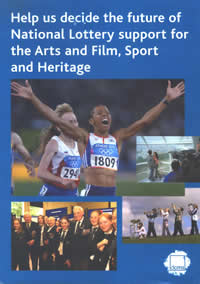 An altogether more lamentable example fell into my hands this morning. It’s a leaflet titled, “Help us decide the future of National Lottery support for the Arts and Film, Sport and Heritage “. This so-called consultation is, in fact, one of the most loaded pieces of market research I’ve ever seen. There are seven closed-ended questions about lottery funding and this one is entirely typical.
Lottery money has provided a fantastic legacy of sporting facilities from playground to podium including many swimming pools, playing fields, sports halls and athletics tracks. We believe it has also been key to improving signifcantly the performance of British athletes at the Olympic Games, helping our athletes compete to the best of their ability and win medals for Britain. Do you agree?
After such an introduction, I was only suprised that they still managed to provide a checkbox for “disagree”.
(There’s a final open-ended section for further comments which looks fairly ridiculous following several pages of this breathless propaganda.)
David Wilcox and Lee Bryant recently posted a thoughtful essay on the problems of getting genuing public participation, the key thought being this (their words, my emphasis)
At the heart of these issues is the question of power and where it lies. Regardless of the quality of techniques employed or facilitation provided, if a participation exercise consists of a powerful body (e.g. a government department) inviting limited submissions on pre-determined questions from the disempowered, then the power imbalance built into the consultation will cast doubt on the results. Power is derived most obviously from being able to choose and frame the questions and the type of language used; but it is also important to consider who is asking the questions, when and how they are asked, and of course who can answer.
This laughable effort from the Department for Culture, Media and Sport is a shocking example of how not to do it.