 Rob Poynton’s book is also very good on the improv notion of acceptance vs blocking. To put it at it’s simplest improvisers are trained to interpret what the other players say or do as offers, which they can either block or accept. Mostly, training tries to encourage more acceptance than blocking. You’ve probably taken part in that exercise where you try to brainstorm ideas in two different ways. In the first, you swap ideas with a partner who has to respond to all offers with buts and in the second with yes, and (or in my preferred version, what l like about your idea is… and).
Of course,there is sometimes tremendous importance in improv (and life) in saying no and blocking. The discussions provoked about the merits of finding the right balance can be endless.
Here’s the point Rob makes that really resonates for me.
.. blocks are assymetric. The emotional force of a block is directed at the person receiving, which means that when you are blocked, you feel it sorely, whereas when you block someone else, you might not even notice. Thus we tend to remember the blocks we receive, not the ones we give, which creates a blind spot.
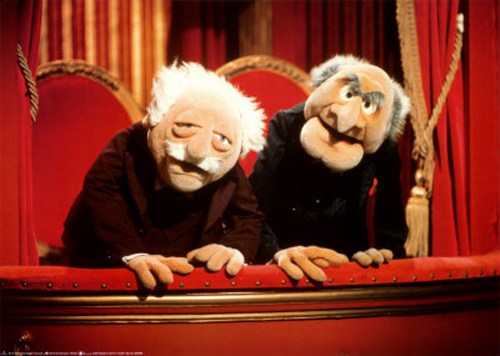
Ain’t that the truth? Any facilitator will tell you the struggle they have not to focus on the small number of critical responses they get. The Statlers and Waldorfs crash into our emotional brains and it’s hard to deal with them. We want to call them difficult people.
Rob’s point about blind spots is really interesting – it accounts for an awful lot of pain in disputes where each party is the martyr to the other’s unconscionable behaviour. Because the real-life Statlers and Waldorfs may not even realise they’re blocking, or the emotional consequences of it.