
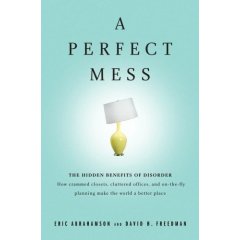
 If you’ve read much of my stuff, you’ll not be surprised I like A Perfect Mess subtitled The Hidden Benefits of Disorder. How Crammed Closets, Cluttered Offices, and On-the-Fly Planning Make the World a Better Place. I kept reading right to the end, a linear response I’m not used to making to non-fiction books.
It’s crammed with interesting anecdotes to support the notion of healthy amounts of disorder. One central theme for me is how we attach a certain moral superiority to order, so that sometimes the only problem with mess is that we feel bad about perpetrating it. Actually, there are lots of benefits to disorganisation – it can support greater innovation (more chance of random stimulation) and flexibilty. And often there are hidden costs to order – the stress of having to constantly refile things to maintain it.
One touching example is the Little Red Wagon nursery, where the conventional norms of teaching are suspended. There are no standard ABC alphabet posters on the walls. Here’s how the founder explains that in the book:
When you put up a poster with the alphabet, you telling the children several things…. That they’re supposed to learn them in this order. That the apple in ‘A is for apple’ is a red apple, so that I guess apples are supposed to be red. But what you’re not telling them is ‘why’. Why do they have to learn the ABCs? Why should the color apples red?
We go on to learn about Red Wagon’s unschooling methodology, in which teachers follow the curiosity of the children, with excellent results. I loved this in particular:
One boy started pounding on a doll with a block; instead of admonishing him, a teacher expressed interest, and the boy explained he needed an injured patient on which to practice medicine. Soon half the class was involved in running a hospital.
Bonus links: Other reviews of the book by Kate at 800CEORead, by a professional organiser and Adam Jusko:
These guys have dozens of other fun, messy stories you’ll enjoy, and overall the book is a winner. Know where it falters, though? When it attempts to categorize types of messiness, define the methods people use in dealing with mess, etc. Come on, guys, it’s a book about mess. Don’t mess it up by trying to neaten it.



