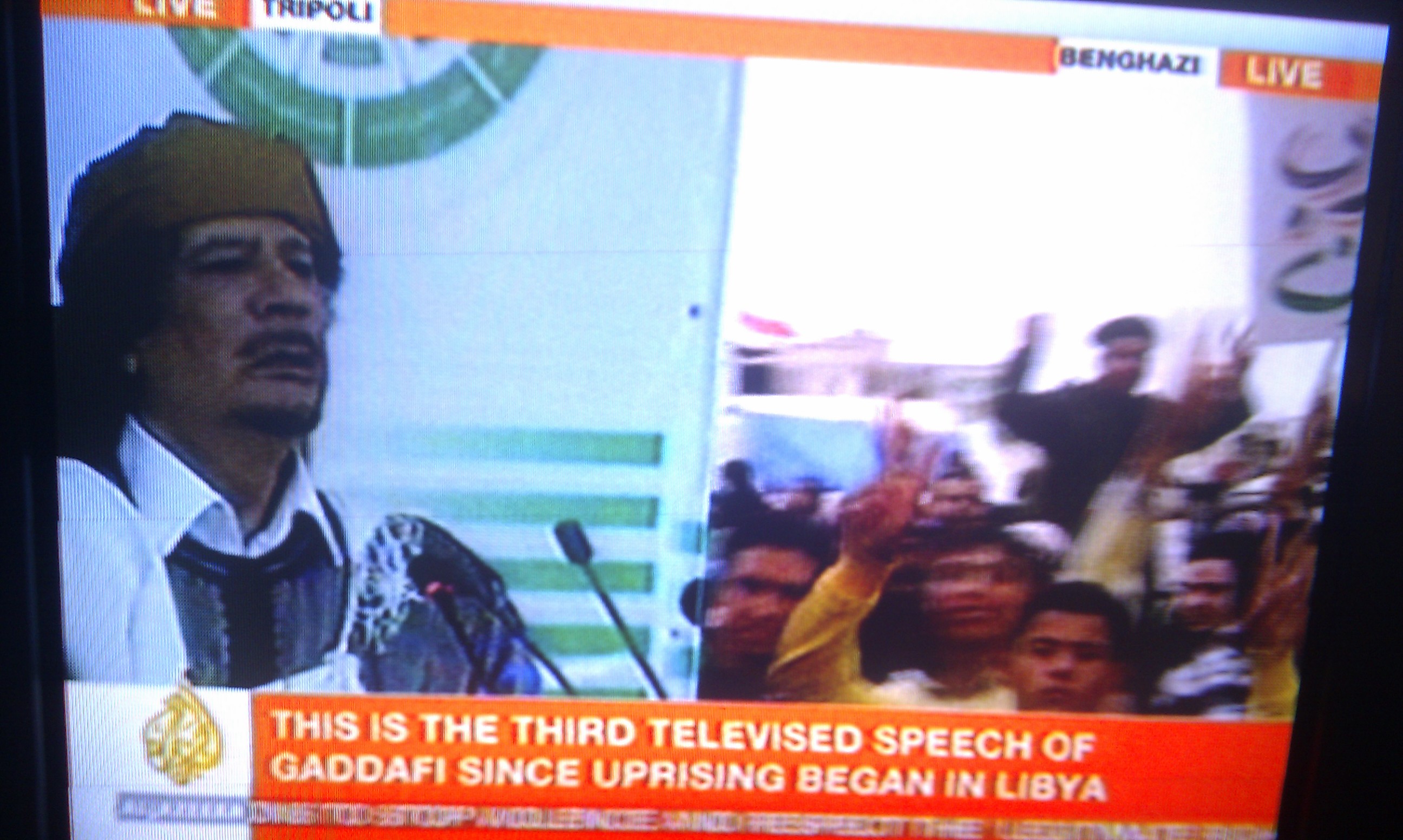
I captured this split screen from Al Jazeera on my phone.
Each day this week Viv McWaters and I have been sharing experiences with a group of facilitators from many parts of the world. One theme to which we keep returning is the value of breaking out of one-to-many formats for meetings. We all know about death by powerpoint but we’re arguing that the failing extends way beyond slideshows to all sorts of keynotes panels and Q and A sessions. It costs a lot of money to get a group of people in a room together; how can we justify then simply having one person transmit information to them? If you want to transfer information one-to-many, why not do so over the net, in advance, allowing people to digest it at their leisure? So when they meet they can do what they can’t do well online, which is converse with access to all the cues and signals that are only possible when we gather face-to-face, body-to-body.
Of course, there’s a vast industry devoted to training people to give better presentations, But I often wonder if it would be better to stop pressuring people to do star turns and let them do what is more natural – which is to have conversations.
Sometimes it’s argued that a conversational approach is likely to lead to misunderstandings, a la chinese whispers. Again, I’d say that’s where there’s a role for material sent in advance in words or video. And conversational formats offer more opportunities for errors to be identified, rather than magnified. And as we’ve learnt several times recently, it’s dead easy for phrases dropped into one-to-many presentations to be interpreted in a variety of ways anyway.
Viv shared a process nicknamed speed dating in a short talk. It was only in conversation two days later that a participant explained the he’d heard “speak dating” and had been puzzled throughout.
We also argue that setting up a format in which one person has status over others easily creates what we’re calling a Teacher Trance. The speaker gets repeated signals that he’s supposed to be authoritative, and becomes quite attached to the power and/or responsibility. The same applies in reverse to the audience, contributing to a feedback loop in which both become deluded… until the system breaks down.
So it’s interesting to return to my hotel room and see the Al Jazeera coverage of Libya. In this shot, on one side we see Gaddafi rambling on in front of an invited audience. Cutaways reveal row upon row of impassive faces… either bored or frightened or both. On the other side, are the crowds in Benghazi, who are passionate and colourful. One holds a sign saying what we’re hearing is a lie, such is the liveness of communications these days. Oh, you might say they are a little chaotic… but where is the energy? The dictatorship is ordered and ultimately fragile. The rebellion may has on clear leader, may appear chaotic, but starts to look like it will have the upper hand.
The Teacher (or Leader) Trance is pernicious, and it often sets itself up for a sudden collapse.