Harold Jarche reflects on Tom Gram’s post Everyday Experience is not Enough. Tom argues:
No one in their right mind would argue that experience is not a powerful teacher or that our most valuable learning occurs while working. But it’s pretty broad generalization don’t you think? Some experiences must be more valuable than others for achieving learning and performance goals…. Indeed research in developing expertise has shown that not all experience is created equal. Years of experience in a domain does not invariably lead to expert levels of performance. Most people after initial training and a few years of work reach a stable acceptable level of performance and maintain this level for much of the rest of their careers.
He uses this graphic to capture the point:
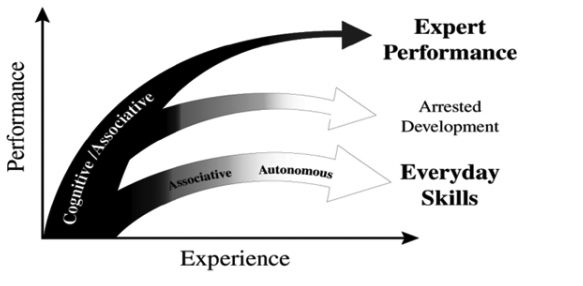
Ericsson K.A., “The Influence of Experience and Deliberate Practice on the Development of Expert Performance” The Cambridge handbook of expertise and expert performance (2006)
Self-directed learning can be fantastic because it acts on high levels of intrinsic motivation but without space for useful feedback and reflection, it can lead to a real plateau in performance.
When I’m doing training I go very light on theory and methods, and very heavy on exercises, practices and simulations. I also attempt to set up feedback to be constructive and generative and not excessively judgemental or definitive. I think this makes it easier for the learner to stay on their edge: that area where they are encountering failure or frustration, but learning and keeping going. What keeps them engaged and motivated is the experimentation to find their own answer rather than attempting to comply with some externally provided sense of what is correct.
(Viv points to why the edge is such an interesting place.)
—–