I’ve read and greatly enjoyed Daniel Goleman’s stuff on Emotional Intelligence.
But I feel unhappy about his involvement with Hay Consulting where he endorses their impressively titled “Emotional Competence Inventory Accreditation” by saying:
“The ECI is the only instrument that incorporates the full depth of my research and that of my colleagues. Other instruments use the words “Emotional Intelligence” but the ECI is the genuine article.”
Basically what we are offered here are a set of “tools” purporting to measure the Emotional Intelligence of people in organisations.
The language used raises red flags for me. Let’s start with “instruments”… reminds me of the Spanish Inquisition’s delightful instruction to its market researchers:”show them the instruments”.
Instruments are great for showing what’s going on inside engines. I really like to know how fast my car is going. But instruments for helping people manage relationships?
Then “tools”. I use tools to fix machines.. the idea of a “tool” for use on living breathing people does not appeal. This all smacks of the mechanistic model of the world which is so pervasive in business these days.
Hay continue:
Executive coaches can use the ECI to provide clients precise and focused feedback on their strengths and limits. Based on the feedback from a variety of rater groups (i.e. self, manager, direct reports, peers, others), the ECI indicates the specific emotional competencies where development is needed to enhance the individual’s emotional intelligence.
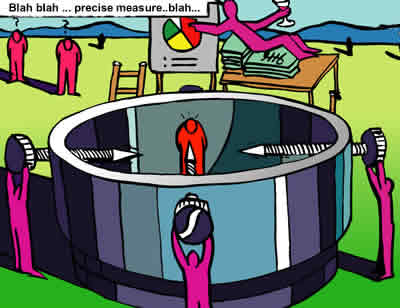
Theres a nice list of all the things that Hay’s little micrometer can measure for you.
So this company doesn’t just measure Emotional Intelligence. It does it with precision. To me that is deeply implausible. These guys want us to believe they can say precisely how empathetic you are; they can identify precisely your level of trustworthiness and precisely the extent of your optimism.
Of course, some businesses are lapping this stuff up. They will love a device that tells them – let me guess – that one manager is 12.3% more empathetic/optimistic/charismatic/sociable than another. As if a human’s qualities are some fixed thing.
For one thing, human attitudes and behaviour are contextual… a rating for any quality will give no idea of how a person will behave in different contexts. And a corporate culture can have a huge impact; it’s not simply reducible to an adding up of individuals’ test results.
For another, I deeply question the value of averaging feedback from a diverse group of people to form a picture of one person’s character. (and I see here that the value of the research behind it is being questioned in many circles)
And what really concerns me is that these “instruments” provide beguiling numbers so that the users don’t actually have to consult the evidence of their senses in assessing and relating to people. And they bypass what – in my personal experience – can be the most helpful thing for developing emotional intelligence in a group, which is direct and honest feedback from one person to another. Not some empty “average” but specific information about specific behaviours and their impact, good or bad.
Businesses need to develop the sensitivity and self-awareness to actually engage in the mysteries of human relationships in a spirit of spontaneity rather than one of measurement and control. It’s not about giving out points for personality.
It’s about getting over the fear of honesty and authenticity in communication. That fear will – I think – be made worse not better by running popularity contests and handing out school reports on what people “must do better”.
I don’t dismiss psychographic tests of various kinds out of hand; but I think this material presents such work in a very bad light. I think it’s a sell out to the mindset that says “You can only sell things to businesses by giving them hard numbers”.
But perhaps there is one thing that the Hay Group will identify with some of their remarkable “precision”: the sort of people who actually buy this may be precisely the managers who need to learn about what real emotional intelligence is. Cos this set of instruments is not it.
Oh and here is my friend Julian Burton‘s image satirising such “instruments” for managing human beings. I think it speaks volumes.