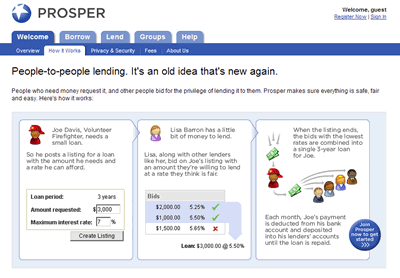
 A few days ago James and I chatted over Skype with Chris Larsen and John Witchel of Prosper. They are, like Zopa (to whom we spoke in February), a new online marketplace for people to lend and borrow money, person-to-person. A kind of eBay for money. The Prosper model puts more emphasis on group forming, encouraging borrowers to join up as members of a social group. This is designed to encourage more word-of-mouth marketing, but also to increase creditworthiness.
Prosper is a fascinating Web 2.0 innovation, and I hope you’ll listen.
 Download the Podcast – 18m 20s – MP3 (10.5MB)
 Podcast RSS feed for iPodder etc.
Show notes
These shownotes below are not a transcript, but my paraphrasing of what we asked and how John and Chris answered.
0.00 Introductions
0.55 What does Prosper do? It’s a people-to-people lending marketplace. We think this provides a new asset class which offers an opportunity for both lenders and borrowers to get better rates. It’s like eBay, but different in that we also handle all the details around repayments, collections, reporting to credit bureaux so people don’t have to get involved in that.
2.25 What’s the experience been to date? Been going a couple of months, pleased so far. In November we launched friends and family period to test the system. On Feb 6th we launched to public. Community seems to be active, so far so good.
3.15 We noticed that you’re trying to set up affinity groups among users where customers gather together to set up accounts. How is that working out? So far, pretty well. There’s been a lot of interest in the groups and activity around them. The purpose of the groups is to create a grassroots effect. Groups play two roles – one they serve as our acquisition tool, two they help capture that sense of reputation or shame, the community glue that means lower defaults over time.
6.10 Seems like an innovation in financial services to go beyond conventional credit scoring… it seems like you are trying to build something that actually creates more security by taking account of people as members of society, not just individuals. Yes, we do the normal credit checking and we also believe in a kind of collective accountability as well, on top of traditional ways of measuring people.
7.30 We want to be open about how groups start, some are going to be very effective and very tight, and some less tight. We trust the marketplace to do a good job of growing the groups with strong reputations and marginalise the groups that don’t add anything to the credit scoring.
8.10 Is the social side of Prosper important or is it all about money? A lot of peer-to-peer ideas have an entertainment component; I think Prosper is different as one of the first Web 2.0 sites where there is an economic consequence of bonds between individuals… so that people’s reputation matters. The behaviour of one individual impacts the whole group and this tends to lead people to behave more responsibly.
10.20 There’s a greater transparency in your model… conventional lending strips the personality out of it; you make it a more social process, increasing the security as a result? We think transparency is key to so many business models now emerging. It speaks to the power of millions of people seeing something and making decisions collectively. We think transparency is a better thing in society and it’s a better thing in credit systems. We think a transparent system will generate better returns and be more socially rewarding too. We sense that for people bidding on listings, they’re not just concerned about making 200 basis points, but there is also a fundamental fascination with people. People can see their money going to things they care about, while making a good return.
14.15 Does openness translate to lower risk? Yes, at all levels from the philosphical to the practical. Transparency creates trust, at a nation level all the way down to a local level. Visibility gives us trust and confidence, right down to whether we put $50 into a listing. Lenders like to know more about the people they are lending to, who they are the community they belong to. For many lenders, it’s not an entirely empirical decision.
16.10 Are some people thinking this is just a finance company exploiting people’s openness? When you look at many new web companies, there is a struggle between transparency and privacy and sometimes those two objectives clash with each other. We’re trying to strike the right balance, with opt-in/opt-out systems letting people be as expressive as they want or remain completely anonymous beyond basic credit information. It’s something we think about all the time.
UPDATE: Dave at Zopa emailed me this link to an ABC news videocast about Prosper. Interesting.